Field notes from a forty-minute road and a four-hundred-year-old kiln.
We drive east, across the Long Biên bridge, and the city begins to fall away behind us.
There is no good reason we still make this drive in person. The Bát Tràng cooperative would courier ceramics to us.
5:40 AM — Hàng Da
The shop is still closed when we leave. We load two empty cardboard boxes, a thermos of weak green tea, and an old camera into the back of the van. The street is wet — it rained overnight — and the wholesale flower vendors at the corner of Hàng Mã are already loading bouquets onto their bicycles. They nod at us. We nod back. Wednesday rhythms.
We drive east, across the Long Biên bridge, and the city begins to fall away behind us.
There is no good reason we still make this drive in person. The Bát Tràng cooperative would courier ceramics to us. Quang’s family would deliver. A phone call would do. But there is a difference between receiving an order and choosing each piece off the kiln, and the difference is the entire reason this brand exists.
So we drive.
6:25 AM — Arrival
Bát Tràng on a Wednesday morning is not the Bát Tràng of weekend tour buses. The pottery market at the entrance is half-asleep. The big tourist showrooms — the ones with mass-produced rice bowls in fluorescent glazes, the ones whose pieces we will not touch — are still shuttered. We turn down a side lane past the village temple and pull up at a low courtyard house with no signage.
Quang is already at the wheel.
He has been at the wheel since five. He keeps potter’s hours — the wood-fired kiln he uses requires firing through the night, and the family rotates shifts. His wife is asleep in the back of the house. His daughter is at school in town. His father, eighty-two, is sitting in the courtyard drinking tea and watching pigeons. The father waves at us. We wave back. We have, by now, been waved at by three generations of the same family.
The morning’s smell is unmistakable: wet red clay, woodsmoke from the cooling kiln, the faint vinegar tang of fermenting glaze in covered jars by the wall.
6:40 AM — Tea, before anything else
We do not look at the ceramics first. This is a rule we learned the hard way during our first visit, when we walked in pointing at pots and Quang’s face closed politely. In Bát Tràng — in most of craft Vietnam — you drink tea first. You ask after the family. You comment on the weather. You eat a small piece of bánh đậu xanh. You allow time to pass.
Only then do you talk about work.
The tea this morning is a green from Thái Nguyên, second harvest, brewed weak in a small clay pot Quang made himself. He pours into three cups — for him, for us, for his father — and we sit on low stools and talk about the rain. About the price of clay. About whether the daughter, fourteen, will continue the wheel or whether she will become an architect like her cousin in Đà Nẵng. (She has, last we heard, expressed interest in both.)
This is forty minutes of our morning. None of it is wasted.
7:30 AM — The kiln, opened
Quang’s kiln is wood-fired, of a type the village calls lò bầu — a long, climbing brick kiln with a series of connected chambers. It is fed with eucalyptus, pine, and longan wood, depending on the firing. Each firing takes about eighteen hours. After firing, it cools for thirty-six hours. Quang fires twice a month, sometimes three times if the season is good.
This morning’s batch came out of the kiln yesterday afternoon. The pieces have been resting overnight to fully cool, and now Quang lifts them out one by one and arranges them on a long wooden plank in the courtyard. We do not speak. This is the part of the morning that requires attention.
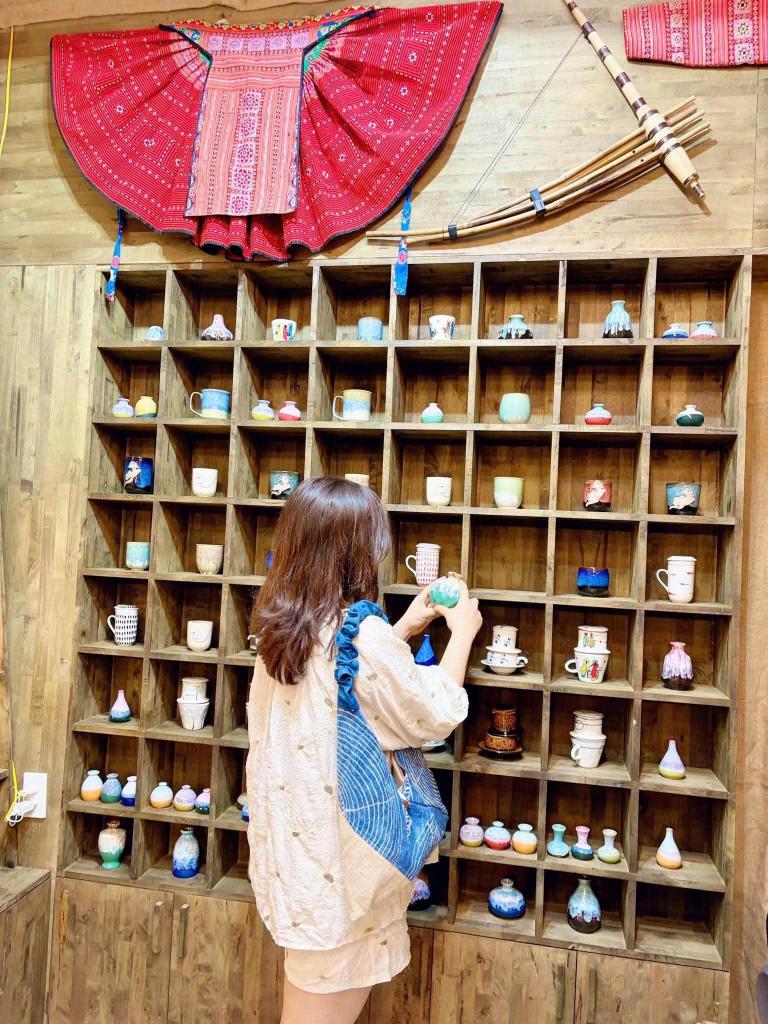
There are perhaps a hundred pieces — teapots, cups, small plates, a few larger vases. They are not identical. They cannot be. A wood-fired kiln does not produce identical pieces. Some have caught more ash on the shoulder, where the flame curled. Some have a faint pink blush on the rim from being closer to the firebox. Some have small dark specks where a piece of fly-ash settled on the glaze during firing.
These are the pieces most worth buying.
8:10 AM — Choosing
We choose by hand and by eye, slowly. We pick up each piece. We hold it. We turn it. We tap the rim lightly with a knuckle to listen for the ring of a well-fired body (a dull thud means a hairline crack, invisible to the eye, that will fail in three months).
We are looking, today, for:
A small batch of twelve teacups for the pour-over bar — we are running low. We want cups with the celadon-ash glaze, slightly rough on the foot, with the small kiln signatures we can point out to customers as marks of authenticity.
A pair of larger teapots, ash-glazed, for a customer in Tokyo who has been waiting since March.
A set of six small dipping plates for a restaurant friend in the Old Quarter.
And — if we are lucky — one or two pieces with the kind of dramatic firing accident that we cannot plan for and cannot order. A celadon teapot with a long iron-black flame mark down one side. A small bowl whose glaze cracked just so during cooling. These are the pieces that will become the centrepieces of our shelves. These are the pieces a traveler from Paris will come back for, six months later, to ask after.
This morning, we find one. A small cup with a pool of dark blue glaze in the bottom — not by design; the glaze pooled during firing where the cup leaned slightly off-true. The cup is, by any factory standard, a defect. By our standards, it is a small piece of accidental art.
We pay an extra hundred thousand đồng for it. Quang shrugs. He thinks we are overpaying. We think he is undercharging. This is the friendly impasse our friendship is built on.
10:15 AM — Lunch, briefly
We eat bún chả at a stall three lanes over from Quang’s house. The grilled pork is from a butcher Quang’s wife uses. The herbs are from the garden behind the stall. There are four plastic stools. We sit on three of them. The fourth is occupied by a small grey cat who, by mutual agreement, has earned a permanent place.
We do not, during lunch, talk about work. We talk about the rain again. About a film someone has seen. About whether Bát Tràng’s tourist development is good for the village or bad. (Quang’s view: complicated.)
11:30 AM — The drive home
The two cardboard boxes in the back of the van are full. The pieces are wrapped in newspaper — the same newspapers Quang’s father saves from the previous week, the same newspapers we re-use to wrap shipments to customers. Nothing in this chain is glamorous. Most of it is paper, cardboard, hemp string, and the steady, unphotogenic work of people who have known each other for years.
This is what direct sourcing actually looks like. Not a glossy supply-chain video. Not a marketing slogan. A van. A morning. A pot of tea. A wheel that has been turning since five.
We are back at Hàng Da by half-past noon. We unpack onto the shelves. The small cup with the pooled glaze goes in the front window. Someone, eventually, will pick it up.
When they do, we will tell them about the morning. We will tell them Quang’s name. We will tell them about his father, who is eighty-two, who was waving at the pigeons.
We will tell them, in short, the truth.