


The founding story of Hmong Craft & Coffee — in three encounters and a quiet vow.
There is a moment, late on a winter afternoon in Hanoi’s Old Quarter, when the light turns the colour of weak tea and the souvenir shops along Hàng Gai begin to glow. Lacquered keyrings. Magnets shaped like conical hats. Scarves in synthetic indigo, folded into pyramids on bamboo trays. We used to walk past them on our way home, year after year, and feel a small private grief.
This is how Hmong Craft & Coffee began — not with a business plan, but with a feeling we could not shake.
A friend of ours from Lyon spent two weeks travelling Vietnam in 2019. He came back, sat with us at a corner cà phê đen, and pulled a small bundle from his backpack. “This is what I’m bringing my mother,” he said, slightly embarrassed. It was a scarf — soft enough, indigo enough — but we both knew, by feel alone, that it had never been near a loom. He had paid forty dollars for it. It was worth, perhaps, four.
The grief returned, sharper. Not because he had been overcharged — though he had — but because the country itself had been undersold. Vietnam is not a synthetic scarf. Vietnam is months of fermentation and pattern-drawing by candle. And somewhere between the artisan and the traveler, the country was being lost in translation.
We started to ask, quietly, what it would take to fix that.
The first answer came in a village called Lao Chải, two hours by motorbike from Sapa, in the spring of 2020. We had driven up to meet a weaver — a friend of a friend of a friend — whose name was passed to us in a notebook with no phone number and only a sketch of how to find her house.
Her name was Mỷ. She was forty-three. She had been weaving since she was eleven. She showed us, without ceremony, a panel of brocade she had been working on for three months: a strip of hand-spun hemp, indigo-dyed seven times, with motifs drawn in molten beeswax and rinsed clean after dyeing — geometry her mother had taught her, and her mother before her. The piece was unfinished, and she let us hold it. It was the heaviest light thing we had ever touched.
When we asked the price, she shrugged. The cooperative buyer paid her four hundred thousand đồng — perhaps fifteen dollars. The same piece, finished, sat in a Hanoi tourist shop with a tag of one million two hundred thousand. The numbers we had known abstractly suddenly had a face, a household, a small kerosene lamp burning in the corner.
We drove back to Hanoi mostly in silence. We had not yet decided to start a company. But we had, without admitting it, already begun.
The second answer came from a man named Quang, who threw teapots in a Bát Tràng courtyard forty minutes east of our apartment. He was the fourth generation of his family to work the same Red River clay. His kiln was wood-fired, fed at four in the morning, banked at midnight, the same rhythm his great-grandfather had kept.
We asked him, foolishly, whether the wood kiln was difficult to keep running. He looked at us as if we had asked whether breathing was difficult. The kiln was not a tool. The kiln was the village. You did not stop the kiln any more than you stopped the river.
He pulled a small teacup off a tray and pressed it into our hands. There was a faint blush on the rim where the flame had touched the glaze too closely. “That’s the fire’s signature,” he said. “Some buyers think it’s a flaw.”
We thought of the gallery shelves of factory ceramics, identical and unsigned, that filled the airport gift shops. We thought of Quang’s hands, which had moved over the same wheel for forty years. The distance between those two objects — visually, almost nothing; spiritually, an ocean — became the work we wanted to do.
The third answer was the slowest in arriving. It came in a coffee.
A friend who roasts in District 3 invited us to taste a small lot of washed Arabica from a H’Mông-run farm in Sơn La, fifteen hundred meters up the limestone slopes. We had grown up on Robusta — the thick, dark, sweetened-condensed kind every Vietnamese knows. Specialty Arabica from our own country was, to us, almost a rumour.
The cup poured pale gold. We smelled apricot, cocoa nib, the wild-honey edge of bee balm. We tasted, and we did not recognize the country we had been drinking our whole lives. This was Vietnam, too. This was Vietnam that the world had never been invited to meet.
The farmer’s name was Sùng. He had been processing his own beans for six years, drying them on raised beds, fermenting in tanks the size of bathtubs. He sold most of his harvest to a Norwegian buyer who never came to the farm. Our friend the roaster paid more, came up twice a year, sat on the porch.
We left that cupping with the third piece of the puzzle, and the shape of the company became, finally, undeniable.
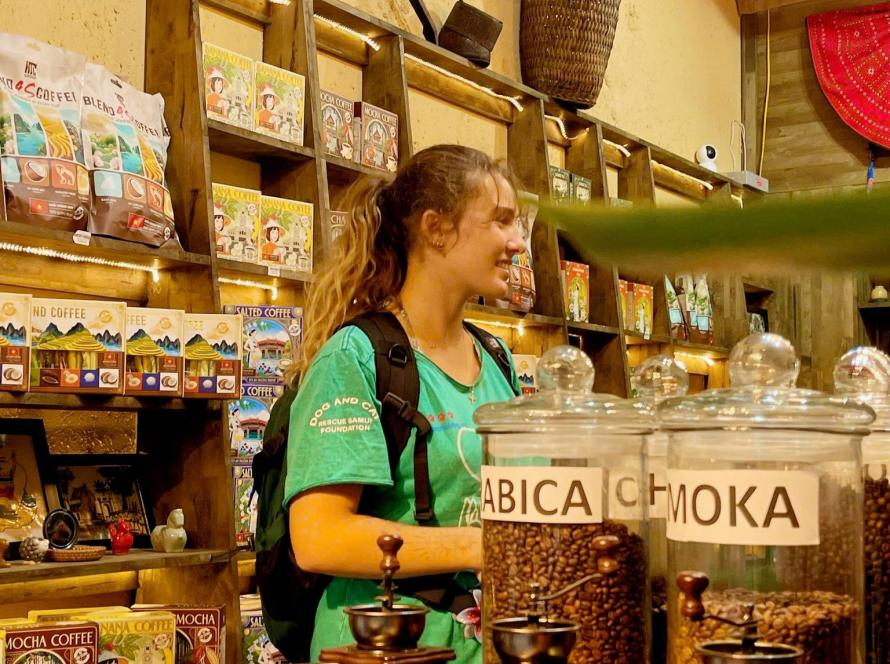
We opened our first door on Hàng Da in the winter of that year. A small front room with a pour-over bar, a wooden stool, and three shelves: ceramics on one, brocade on another, coffee on the third. We did not call ourselves a shop. We did not, honestly, know what to call ourselves.
What we knew was the promise we wanted to keep, written out and pinned above the kettle on our first morning:
Direct from the hands that made it.
Fully made by traditional method.
The story we tell is the story we were told.
We have not changed those three lines since. We do not expect to.
Five years on, we have added a second door on Hàng Bông, a small team of translators and baristas, and a long list of artisans we now visit by name and harvest by harvest. The work is unglamorous more often than not — long drives, slow conversations over rice wine, careful negotiations about price and time. We are not, despite the website, a romantic project. We are a small, stubborn enterprise that believes a country this old deserves to be carried home in something heavier than a magnet.
If you have read this far, you are the reason we exist. Not as a customer — that comes later, if it comes at all — but as someone who suspected, walking past those souvenir shops on Hàng Gai, that there had to be more.
There is. Come sit with us. The kettle is on.

2 Comments
Dorothy
Adipiscing elit, sed do eiusmod tempor incididunt ut labore et dolore magna aliqua ut enim ad minim. Adipiscing elit, sed do eiusmod tempor incididunt ut labore.
Kevin
Sed ut perspiciatis unde omnis iste natus error sit voluptatem accusantium doloremque laudantium, totam rem aperiam, eaque ipsa quae.