MThe road to Mỷ’s house begins where the asphalt ends. You leave the main valley above Sapa around eight in the morning, when the fog is still thick enough that the buffalo on the terraced rice paddies are only suggestions of themselves. The motorbike climbs for forty minutes. The road narrows to a single track, then to two ruts in red clay, then to a footpath. You leave the bike against a persimmon tree and walk.
The house is wooden, low, blackened by sixty years of cooking fire. There is no sign on the door. There is no door, exactly — a curtain of hand-woven hemp, indigo so dark it reads as ink, hung from a bamboo rod. We push it aside and call her name.
She is already at the loom.
Mỷ is forty-three. She was born in this house. She learned to weave when she was eleven, the standard age — old enough to keep her hands steady, young enough that her fingers had not yet committed to a different rhythm. Her mother taught her. Her mother had been taught by her mother. The chain extends, by Mỷ’s count, at least six generations, but probably more — “The women before my great-great-grandmother are not remembered by name,” she tells us in soft H’Mông, “only by the patterns they kept.”
She works on a pedal loom of a kind that has not changed substantially in two hundred years. The frame is bamboo and dark wood. The shuttle is the size of a small fish. Her feet move the pedals; her hands move the shuttle; her eyes do not look at the cloth. They look out the doorway, at the terraces, at the buffalo, at a place we cannot see.
When we ask her how she keeps the pattern straight without watching, she laughs.
“The pattern is not in the cloth. The pattern is in here.” She taps her chest, then her temple. “My mother put it there when I was small. I cannot lose it.”
The women before my great-great-grandmother are not remembered by name, only by the patterns they kept.
She is weaving, this morning, a panel for her own daughter’s eventual wedding. The daughter is fourteen and at school in the valley. The wedding is, by Mỷ’s reckoning, six or seven years away. The panel has been on the loom for two months. It will be on the loom for two months more.
The motifs she is working into the border are pumpkin seeds and spirals — fertility and eternity, the standard bridal vocabulary. But in the centre, she is doing something we have not seen before: a complicated repeating shape, almost like a small key, that she says her mother called txoj kev qhia — “the path of teaching.” It is the motif a mother weaves into her daughter’s bridal cloth when she wants the daughter, in marriage, to remember what she was taught.
“My mother put this on my own wedding panel,” Mỷ says. “I did not know what it was at the time. I asked her years later. Now I know, and I am putting it on my daughter’s.”
There is no museum in Vietnam, as far as we are aware, that documents this particular motif. There is no book. There is only Mỷ, and her mother, and a chain of women going back into the unrecorded country before her great-great-grandmother.
This is what is at stake when a panel like this is bought, undercut, or copied by a printer.
Mỷ’s hands are the hands of a woman who has been working hemp for thirty-two years. The fingernails are short, square, and slightly stained where the indigo has worked permanently into the cuticle. The pads of her fingers are calloused, but not in the way a labourer’s hands are calloused — the callouses are small, located precisely where the shuttle and the beeswax pen contact the skin. They are the callouses of a specialist.
When she hands us a sample of finished cloth to feel, her grip is precise. She takes the cloth by the corners, never by the surface. “The oil from a hand can settle into the indigo,” she explains. “Years from now, the place a stranger touched will be a different colour.”
We adjusted how we handle the cloth in our shop after that morning. We pass everything by the corner now.
We ask her about money. We have learned, in five years of doing this, to ask plainly. The roundabout politeness of urban Vietnamese small talk has no place at a H’Mông weaver’s loom; it costs her time, and time, at her loom, is the only currency that matters.
The panel she is making for her daughter — the wedding panel — would sell, finished, in a tourist shop on Hàng Gai for around forty US dollars. She would not sell it; it is for her daughter. But the same kind of panel, sold through the cooperative buyer who comes once a season, would pay her fifteen dollars at most.
We pay her thirty for a comparable panel, picked up directly. We are not, by tourism-pricing standards, generous. We are, by cooperative-pricing standards, paying double. The difference is not because we are good people. The difference is because we know what fifteen dollars and four months of work mean, and we do not believe one woman’s craft should subsidize another’s profit margin.
She nods when we explain this. She does not seem surprised. “You know what the cloth costs,” she says. “Most do not.”
We are there for two hours. We drink small cups of green tea, picked from the bushes behind her house and roasted on a clay stove. She shows us, briefly, an unfinished panel her mother had been working on when she died — twelve years ago now — that she has not yet decided whether to finish or to leave as a memorial. We do not ask which she will choose. It is not our question to ask.
Before we leave, we buy three panels from her — a long strip with the snail spiral, a square embroidered piece with the eight-pointed star, and a smaller travel-sized panel with elephant’s foot motifs running down the spine. She wraps them in old newspaper, ties them with hemp string, and hands them to us by the corners.
“Tell whoever buys these,” she says, “that they were made by Mỷ in Lao Chải. I would like them to know.”
Mỷ does not have an Instagram account. She does not, as far as we can tell, have a phone with internet. Her name appears in no catalogue, no museum register, no academic paper.
It appears now on a small handwritten tag tied to every panel of hers we sell. It also appears at the top of this article. This is the smallest possible thing we can do — and, we suspect, the most important.
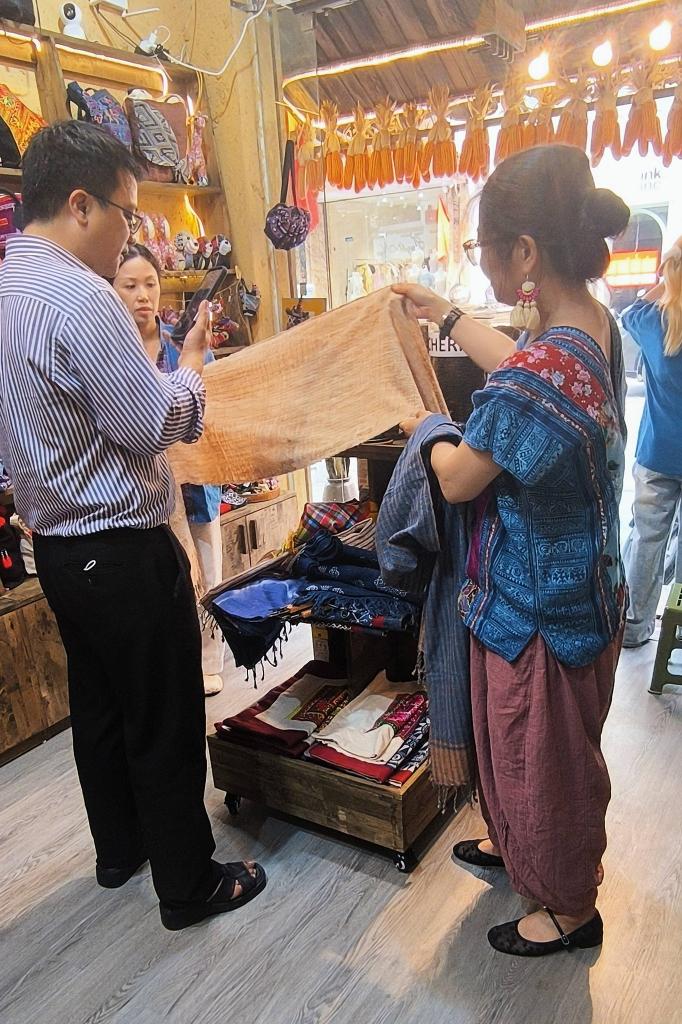
If you ever come into our shop on Hàng Da and lift a panel of brocade off the shelf, look first for the tag. Read the name. Then, if you wish, ask us about her.
We will tell you what we know. The rest, she has kept in her chest and her temple, where it has been kept by women like her for as long as any of us can remember.